
Important Dates Paper Submissions Program Program Committee Speakers Organizers
First Workshop on Affordances: Affordances in Vision for Cognitive Robotics (in conjunction with RSS 2014), July 13, 2014, Berkeley, USA
 |
 |
Based on the Gibsonian principle of defining objects by their function, "affordances" have been studied extensively by psychologists and visual perception researchers, resulting in the creation of numerous cognitive models. These models are being increasingly revisited and adapted by computer vision and robotics researchers to build cognitive models of visual perception and behavioral algorithms in recent years. This workshop attempts to explore this nascent, yet rapidly emerging field of affordance based cognitive robotics while integrating the efforts and language of affordance communities not just in computer vision and robotics, but also psychophysics and neurobiology by creating an open affordance research forum, feature framework and ontology called AfNet (theaffordances.net). In particular, the workshop will focus on emerging trends in affordances and other human-centered function/action features that can be used to build computer vision and robotic applications. The workshop also features contributions from researchers involved in traditional theories to affordances, especially from the point of view of psychophysics and neuro-biology. Avenues to aiding research in these fields using techniques from computer vision and cognitive robotics will also be explored. Primary topics addressed by the workshop include the following among others
- Affordances in visual perception models
- Affordances as visual primitives, common coding features and symbolic cognitive systems
- Affordances for object recognition, search, attention modulation, functional scene understanding/ classification
- Object functionality analysis
- Affordances from appearance and touch based cues
- Haptic adjectives
- Functional-visual categories for transfer learning
- Actions and functions in object perception
- Human-object interactions and modeling
- Motion-capture data analysis for object categorization
- Affordances in human and robot grasping
- Robot behavior for affordance learning
- Execution of affordances on robots
- Affordances to address cognitive and domestic robot applications
- Affordance ontologies
- Psychophysics of affordances
- Neurobiological and cognitive models for affordances
Location
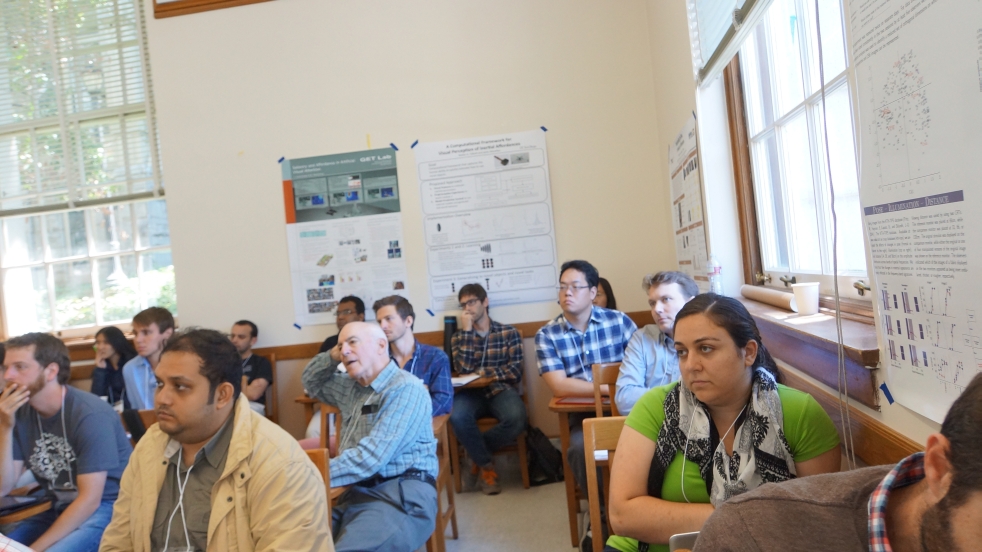
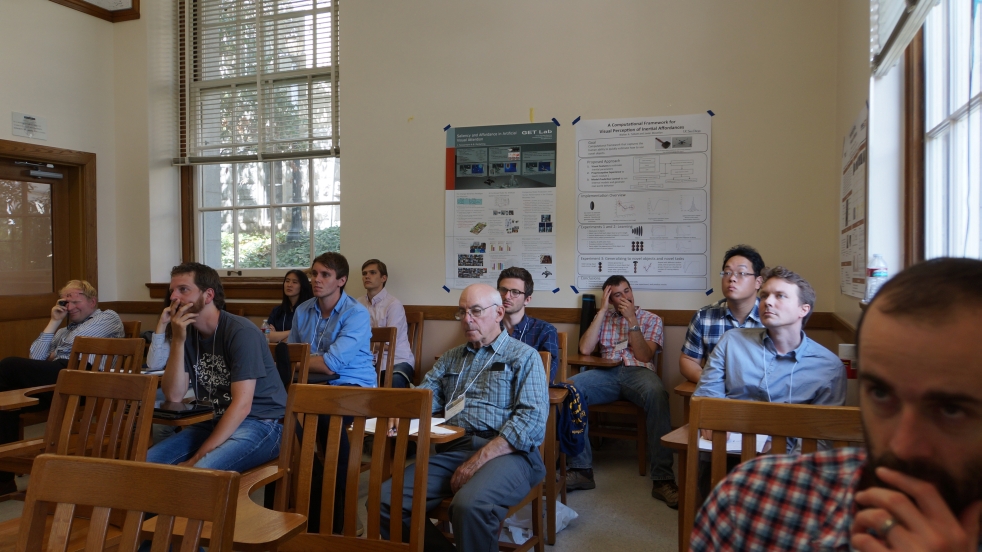
| Wheeler 100, UC Berkeley Campus |
Organizers
- Karthik Mahesh Varadarajan (varadarajan(at)acin.tuwien.ac.at), TU Wien
- Markus Vincze (vincze(at)tuwien.ac.at), TU Wien
- Trevor Darrell (trevor(at)eecs.berkeley.edu), UC. Berkeley
- Juergen Gall(gall(at)iai.uni-bonn.de), Univ. Bonn
 |
 |
 |
 |
| Karthik Mahesh Varadarajan | Markus Vincze | Trevor Darrell | Juergen Gall |
Program Committee
- Prof. Aude Oliva (MIT)
- Prof. Fei-Fei Li (Stanford University)
- Prof. Martha Teghtsoonian (Smith College)
- Prof. Derek Hoiem (UIUC)
- Prof. Barbara Caputo (Univ. of Rome, IDIAP)
- Prof. Song-Chun Zhu (UCLA)
- Prof. Antonis Argyros (FORTH)
- Prof. Tamim Asfour (KIT)
- Prof. Trevor Darrell (UC. Berkeley)
- Prof. Michael Beetz (TUM)
- Prof. Norbert Krueger (Univ. of Southern Denmark)
- Prof. Sven Dickinson (Univ. of Toronto)
- Prof. Diane Pecher (Erasmus Univ. Rotterdam)
- Prof. Aaron Bobick (GeorgiaTech)
- Prof. Jason Corso (UB New York)
- Prof. Juan Carlos Niebles (Universidad del Norte)
- Prof. Tamara Berg (UNC Chapel Hill)
- Prof. Lisa Oakes (UC Davis)
- Dr. Moritz Tenorth (Univ. Bremen)
- Dr. Dejan Pangercic (Robert Bosch)
- Dr. Roozbeh Mottaghi (Stanford)
- Dr. Alireza Fathi (Stanford)
- Xiaofeng Ren (Amazon)
- David Fouhey (CMU)
- Tucker Hermans (Georgia Tech)
- Tian Lan (Stanford)
- Amir Roshan Zamir (UCF)
- Hamed Pirsiavash (MIT)
- Walterio Mayol-Cuevas (Univ. of Bristol)
Program
 |
 |
 |
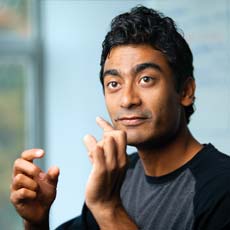
| Abhinav Gupta | Ashutosh Saxena | Jerome Feldman |
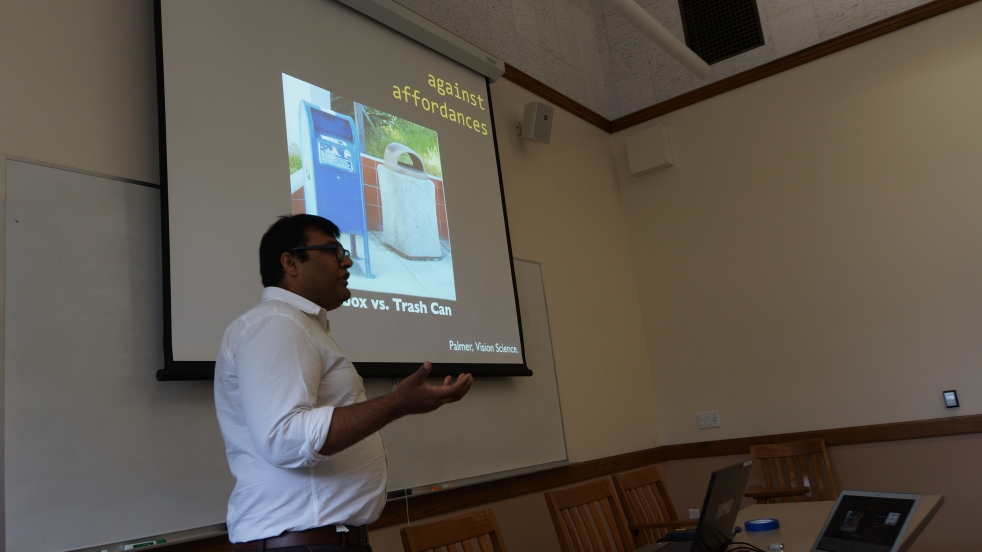
08:30 - 08:45 Introduction to Affordances - Karthik Mahesh Varadarajan - TU Wien
Session 1: Affordances in Computer Vision
08:45 - 09:30 Humans, Objects and Actions - Prof. Abhinav Gupta - CMU
09:30 - 09:40 CV1: Predicting Abnormalities in Complex Human-Object Interaction by using Object Affordance Context - Mahmudul Hassan*, Anuja Dharmaratne - Monash Univ.


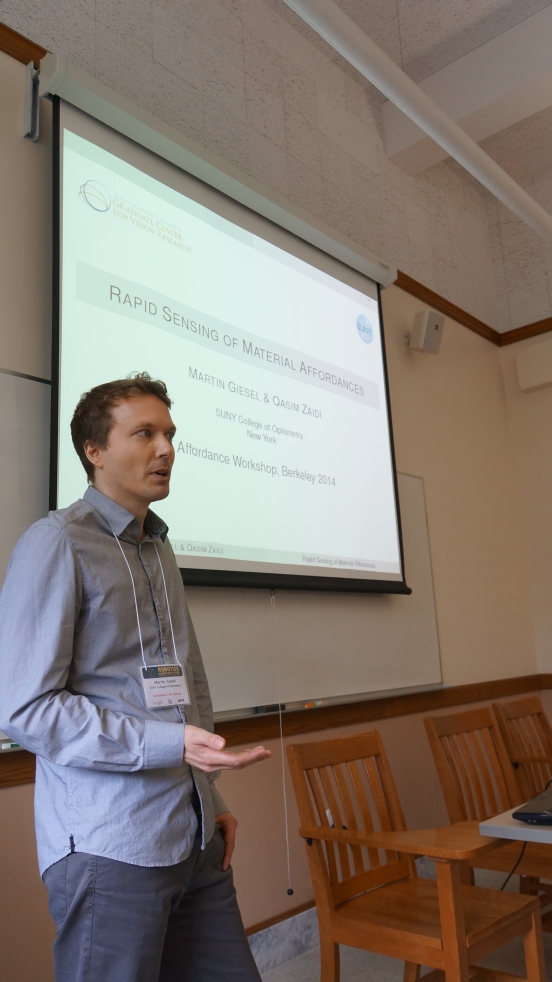
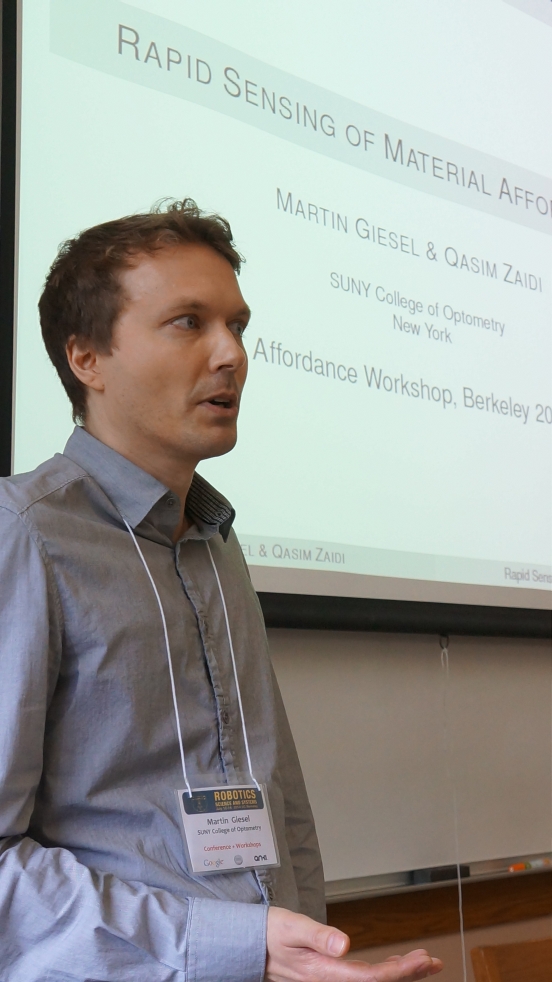
09:40 - 10:05 CV2: Rapid Sensing of Material Affordances - Martin Giesel*, Qasim Zaidi - SUNY
10:05 - 10:20 Coffee Break + Posters
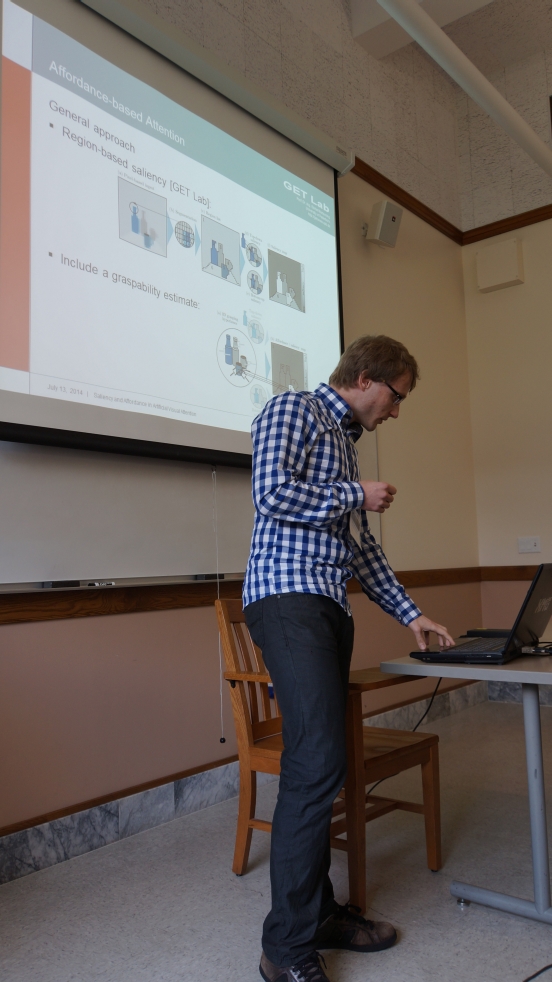
10:20 - 10:45 CV3: Saliency and Affordance in Artificial Visual Attention - Jan Tuennermann, Baerbel Mertsching - Univ. Paderborn
10:45 - 11:05 Open discussion on papers and vision for future research
Session 2: Affordances in Cognitive Robotics
11:05 - 11:50 Physically-grounded Affordances for Perception, Planning and Language - Prof. Ashutosh Saxena - Cornell Univ.
11:50 - 14:50 Lunch break + Posters + FIFA WC Finals

14:50 - 15:00 Posters QA Session
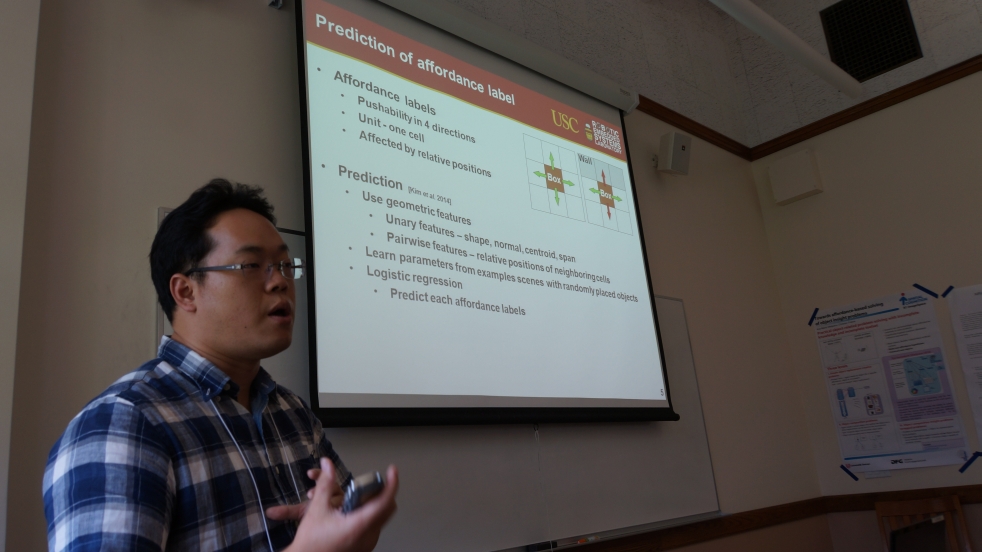
15:00 - 15:10 CR1: Semantic Mapping of Object Affordance by Interactive Manipulation - David Inkyu Kim*, Gaurav Sukhatme - USC
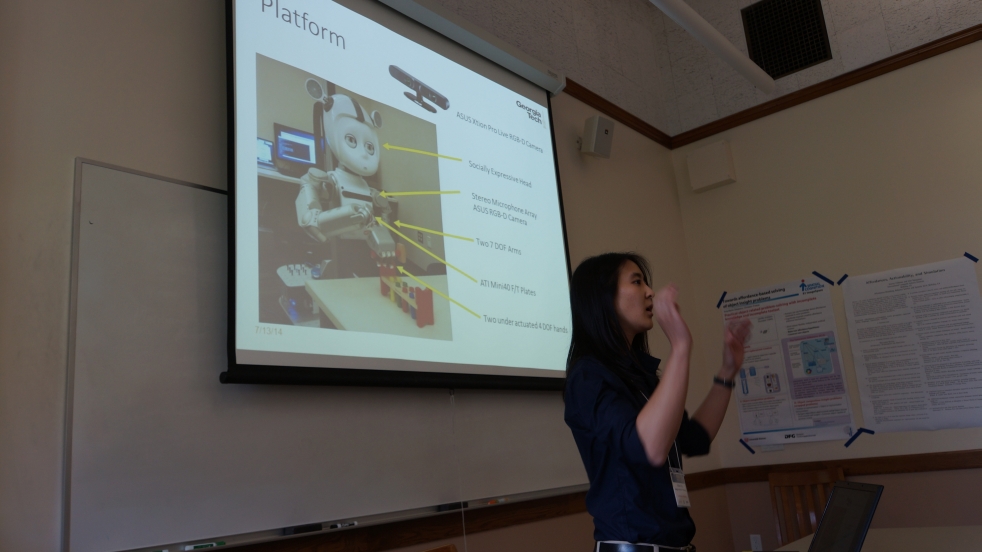
15:10 - 15:30 CR2: Understanding the Role of Haptics in Affordances - Vivian Chu*, Andrea L. Thomaz - Gatech
15:30 - 16:00 CR3: A Computational Framework for Visual Perception of Inertial Affordances - Walter A. Talbott*, Javier Movellan - UCSD
16:00 - 16:20 Coffee break + Posters
16:20 - 16:40 Open discussion on papers and vision for future research
Session 3: Psychophysics and Neurobiology of Affordances
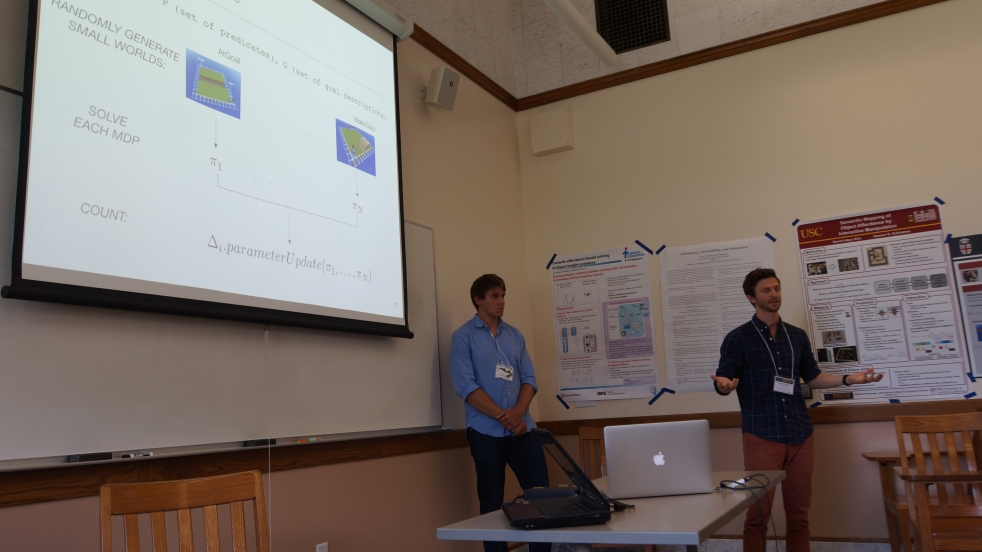
16:40 - 17:10 PN1: Towards Affordance-aware Planning - David Abel*, Gabriel Barth-Maron*, James MacGlashan, Stefanie Tellex - Brown Univ.
17:10 - 17:30 PN2: Towards Affordance-based Solving of Object Insight Problems - Ana-Maria Olteteanu*, Christian Freksa - Univ. Bremen
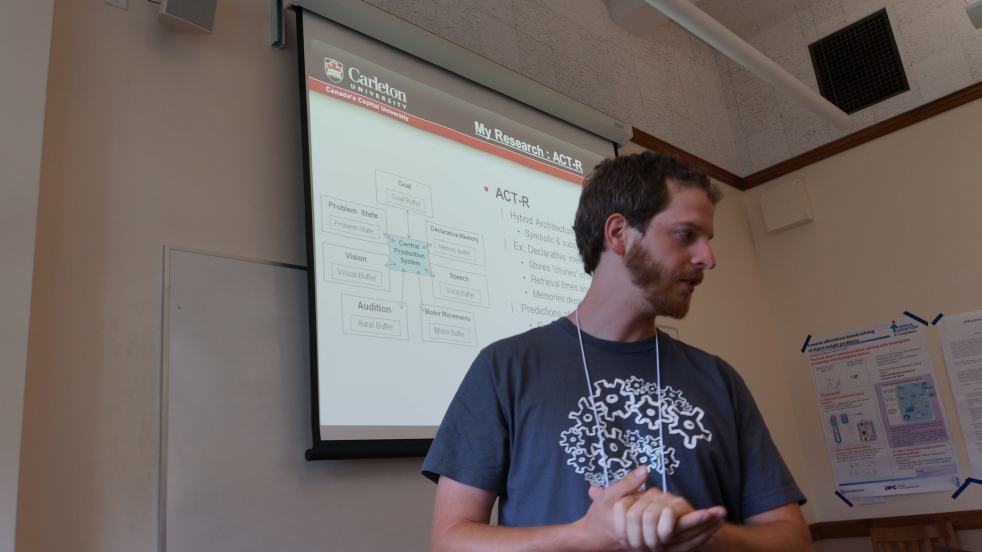
17:30 - 17:50 PN3: A Symbolic Approach to Affordances using SGOMS - Sterling Somers* - Carleton Univ.
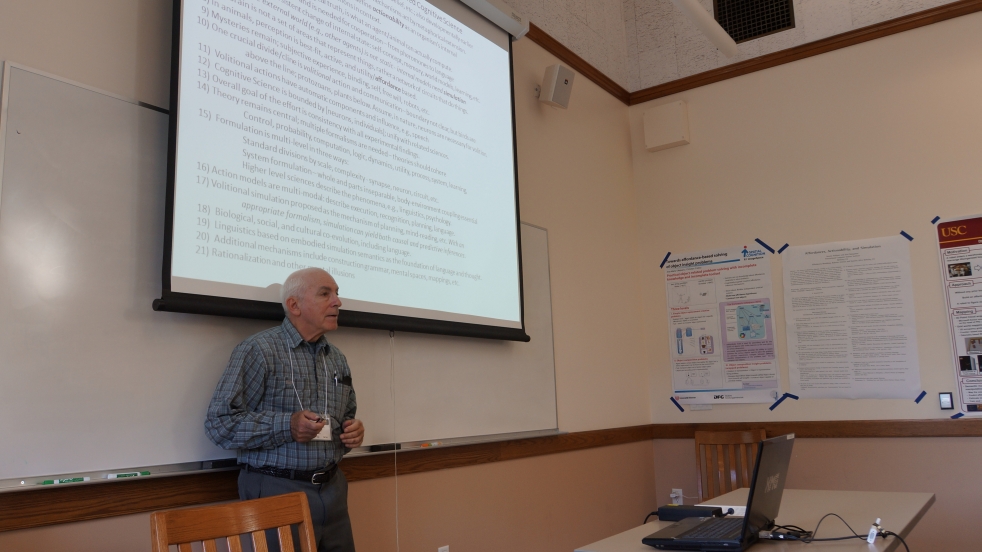
17:50 - 18:35 Affordances, Actionability, and Simulation - Prof. Jerome Feldman - UC Berkeley
18:35 - 18:45 Closing remarks
 |
 |
 |
 |
 |
 |
 |
 |
 |
 |
 |
 |
 |
 |
 |
 |
 |
 |
 |
 |
 |
 |
 |
 |
Paper Submissions
Paper contributions to the workshop are solicited in four different formats- Conceptual papers (1 page): Authors are invited to submit original ideas on approaches to address specific problems in the targeted areas of the workshop. While a clear presentation of the proposed approach and the expected results are essential, specifics of implementation and evaluations are outside the scope of this format. This format is intended at exchange and evaluation of ideas prior to implementation/ experimental work as well as to open up collaboration avenues.
- Design papers (3 pages): Authors submitting design papers are required to address key issues regarding the problem considered with detailed algorithms and preliminary or proof-of-concept results. Detailed evaluations and analyses are outside the scope of this format. This format is intended at addressing late-breaking and work in progress results as well as fostering collaboration between research and engineering groups.
- Experimental papers (3 pages): Experimental papers are required to present results of experiments and evaluation of previously published algorithms or design frameworks. Details of implementation and exhaustive test case analyses are key to this format. These papers are geared at benchmarking and standardizing previously known approaches.
- Full papers (5 pages): Full papers must be self-inclusive contributions with a detailed treatment of the problem statement, related work, design methodology, algorithm, test-bed, evaluation, comparative analysis, results and future scope of work. Submission of original and unpublished work is highly encouraged. Since the goal of this workshop is to bring together the various affordance communities, extended versions/ summary reports of recent research published elsewhere, as adapted to the goals of the workshop, will also be accepted. These papers are required to clearly state the relevance to the workshop and the necessary adaptation.
Each contribution will be reviewed by three reviewers through a single-blind review process. The paper formatting should follow the RSS formatting guidelines (Templates: Word and LaTeX). All contributions are to be submitted via Microsoft Conference Management Tool in PDF format. Appendices and supplementary text can be submitted as a second PDF, while other materials such as videos (though, preferably as links on vimeo or youtube) as a zipped file. All papers are expected to be self-inclusive and supplementary materials are not guaranteed to be reviewed. Please adhere to the following strict deadlines. In addition to direct acceptance, early submissions may be conditionally accepted, in which case submission of a revised version of the paper based on reviewer comments, prior to the late submission deadline is necessary. The final decision on acceptance of such conditionally accepted papers will be announced along with the decisions for the late submissions.
The program is composed of orals, posters as well as Pecha-Kucha style presentations. Papers, presentations and teaser slides will be archived on this website. A non-exclusive copyright grant is also transfered to ArXiv and OpenRsrch archiving systems that permit re-publishing.
Submission of Presentations and Posters
All accepted papers will be presented in the form of oral presentations as well as posters. Discussions over posters will be allocated to coffee and lunch breaks. Authors are expected to be present during the Posters QA Session. Please submit electronic versions of your posters in PDF for archiving via CMT. Printed posters are expected to be of A0 size. Oral presentations will be allocated 10 minutes (for conceptual papers), 20 minutes (for design/experimental papers) and 25-30 minutes (for full papers). A rough recommendation would be to have 1 slide per minute. Please also submit your presentations in PDF/PPT/PPTX format via CMT for achiving. Presentations will be loaded on a workshop laptop to avoid technical issues.Important Dates
- Initial submissions (Early): 23:59:59 PDT May 5, 2014
- Initial submissions (Late): 23:59:59 PDT May 27, 2014
- Notification of acceptance (Early submissions): May 15, 2014
- Notification of acceptance (Late submissions): June 15, 2014
- Submission of publication-ready version: June 22, 2014Transfer of copyrights: July 03, 2014Submission of presentations and posters: July 03, 2014
- Workshop date: July 13, 2014
Please also check out our Second Workshop on Affordances at ECCV 2014 to be held in Zurich, Switzerland.